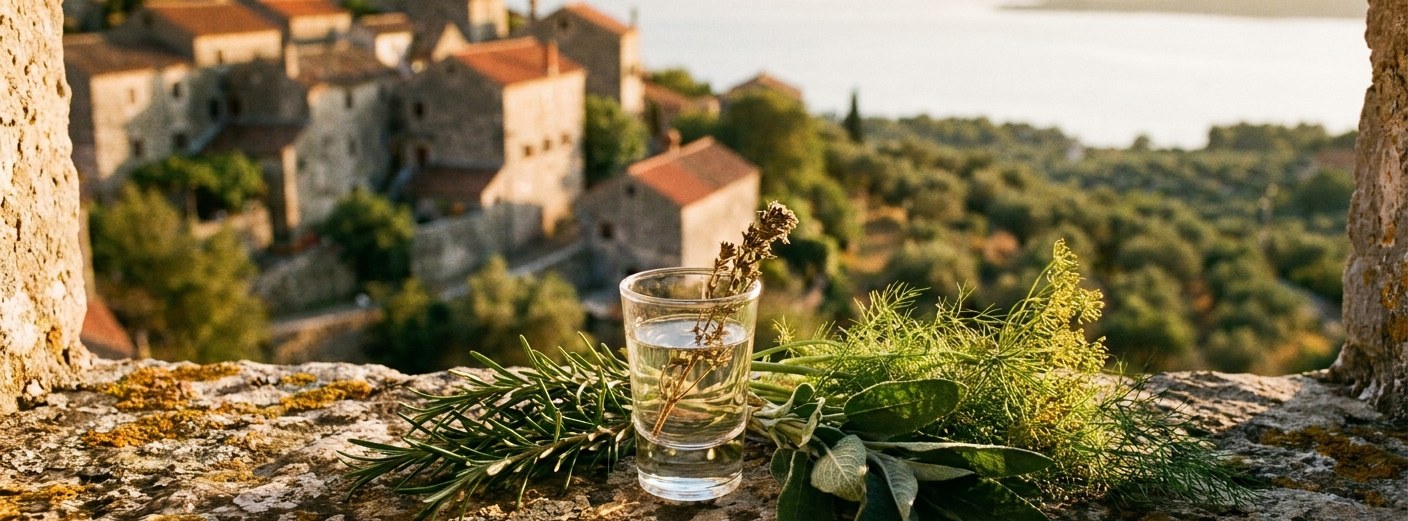
Croatian Rakija
Bok! Dobrodošli! Offering a guest Travarica the moment they step through the door isn't a gesture in Dalmatia — it's closer to a reflex.
Every Balkan country makes Šljivovica, but Croatia's rakija identity is really written along its coast — in the herbs growing wild on Dalmatia's hillsides and islands, and in a wormwood bitter that once supplied European royal courts. This is where rakija stops being just plum brandy and starts tasting like the landscape it came from.
Travarica: Dalmatia's Herbal Welcome
Travarica takes its name from trava — grass, or more loosely, herb — and it's exactly that: a grape-based rakija steeped with aromatic and bitter plants until the spirit carries as much of the hillside as the vineyard. The tradition likely arrived with Venetian trade, which brought aromatic-spirit production to the Dalmatian coast earlier than it reached the rest of the Ottoman-ruled Balkans.
The herbs themselves change with the island. Sage, rosemary, thyme, mint, juniper, and wormwood form the common Dalmatian base, but travel the coast and the recipe shifts: Hvar leans on myrtle (mrtina) for a bitter, dark note; Korčula and Dubrovnik favour anise; Dubrovnik's version is rarely made without bitter orange; and Korčula also reaches for lemon verbena. No two households' Travarica taste quite the same, and that's the point.
What doesn't vary is the ritual. Offering Travarica to a guest on arrival is one of the most recognizable gestures in Dalmatian hospitality — you're handed the glass before you've had a chance to sit down.
Pelinkovac: The Bitter That Reached Royal Courts
Pelinkovac is a different animal — a wormwood-based bittersweet liqueur, built around Artemisia absinthium and up to 35% ABV, served chilled without ice as an aperitif or digestif. Its best-known version, Badel's Antique Pelinkovac, dates to 1862, created by the chemist Franjo Pokorny and originally sold exclusively through pharmacies with a "stomach restorative" label. It worked well enough that Pokorny became a supplier to the Viennese and French royal courts, and the drink found its way to America.
The recipe — wormwood plus 26 other herbs — remains the oldest and most closely guarded in the Badel archive; the original bottle sits in Zagreb's City Museum. It's still respected enough today that USA Today named it to a 2021 list of must-try spirits, liqueurs, and canned cocktails.
Perfect Pairings: Croatian Rakija at the Table
- Travarica + Cured Ham (Pršut): The classic Dalmatian starter — a shot of herbal Travarica alongside thin-sliced pršut and a few olives, before the meal has properly begun.
- Travarica + Fresh Sheep's Cheese: The bitterness cuts cleanly through the richness of island cheese, especially the salty varieties from Pag.
- Pelinkovac + Grilled Fish: Served chilled as an aperitif before a simply grilled catch — the bitterness resets the palate rather than competing with delicate flavours.
- Pelinkovac, neat, after a heavy meal: Its original "stomach restorative" reputation wasn't just marketing — it's still reached for as a digestif after a rich Sunday lunch.
Frequently Asked Questions
What herbs are in Travarica?
It varies by region — sage, rosemary, thyme, mint, juniper, and wormwood form the common Dalmatian base, with island variations like myrtle on Hvar, anise on Korčula and Dubrovnik, bitter orange in Dubrovnik, and lemon verbena on Korčula.
Is Pelinkovac the same as absinthe?
No. Both use wormwood, but Pelinkovac is a sweeter, lower-proof herbal liqueur (around 35% ABV) meant to be sipped as an aperitif or digestif, not a high-proof spirit meant for dilution.
How old is Badel's Pelinkovac recipe?
It dates to 1862, created by chemist Franjo Pokorny. It's the oldest and most secretly guarded recipe in Badel's archive, and the original bottle is on display in Zagreb's City Museum.
Živjeli! Back to the full Rakija guide to explore the rest of the region.