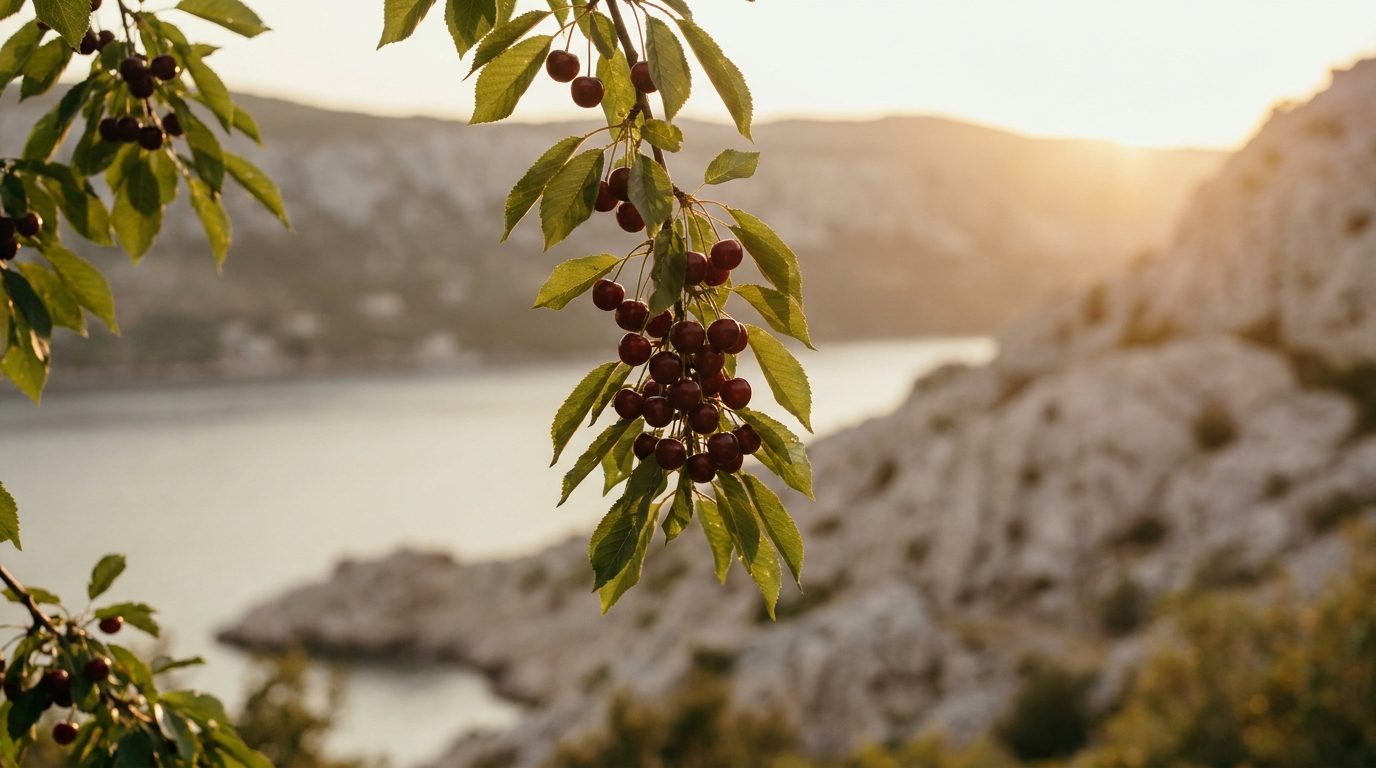
Maraschino Liqueur: The Cherry Liqueur of Zadar
Bok! Every serious cocktail bar keeps a straw-wrapped bottle of maraschino on the shelf. Far fewer of them could tell you that it started on the Dalmatian coast, or why the best-known bottle now comes from Italy.
The Short Version
- What it is: a clear, bittersweet liqueur distilled from sour marasca cherries, stones, leaves and all.
- Where it's from: Zadar in Croatia, a Venetian city when the trade began.
- Strength: typically 32% ABV, or 64 US proof.
- Taste: dry nuttiness, almond and floral notes, with far less fruit than the word "cherry" suggests.
- Best substitute: kirsch with a drop of almond extract.
- Not the same as: the neon-red cherries on a sundae. Those borrowed the name and little else.
What Is Maraschino Liqueur?
Maraschino is a clear liqueur made from the marasca, a small sour cherry that grows along the Dalmatian coast. The fruit goes in with its stones, and in the best-known recipe with leaves and branches from the same trees, and the whole lot is distilled. Sugar comes last. What you get is a colourless, faintly syrupy liqueur at around 32% ABV.
The clear part surprises people. So does the flavour. Most cherry liqueurs are fruit steeped in spirit, which gives you something red, sweet and obvious. Maraschino is a distillate, so the character comes from stones and wood as much as from fruit. A small measure gives a drink structure, which is why bartenders count it in barspoons and quarter ounces.
On pronunciation, the original Italian is mara-SKEE-no, with a hard k. Mara-SHEE-no is common in American English and you will be understood either way, though the bartender may quietly form an opinion.
What Does Maraschino Liqueur Taste Like?
Think roasted almond before you think cherry. The stones bring a marzipan, bitter-nut quality, and the distillate carries a floral, slightly funky lift. Luxardo describes its own bottle as roasted nuttiness on the nose, with hints of dark chocolate, vanilla and orange marmalade on the palate. It is sweet, since it is a liqueur, but the sweetness arrives with enough bitterness that it never tastes like candy.
On its own it is an acquired taste, and not many people sip it neat. It was built to work in small quantities: a little sharpens citrus, rounds out gin and adds a dry nuttiness that is hard to get from anything else.
Where Does Maraschino Come From? A Short History of Zadar's Liqueur
The story usually starts with Dominican friars in Zadar in the 1500s, working out what to do with the marasca cherries of the surrounding coast. Accounts differ on the details, so treat that as tradition. The firmer ground starts in 1759, when the Venetian merchant Francesco Drioli began producing maraschino in Zadar, then known as Zara, on an industrial scale.
- 16th c. The monastery story
Tradition places the first marasca liqueur with the Dominican friars of Zadar, then a Venetian city. It is the story everyone tells and the hardest part to document.
- 1759 Drioli goes commercial
Francesco Drioli, a Venetian merchant, starts industrial-scale production in Zadar, then called Zara.
- 1821 Luxardo arrives
Girolamo Luxardo founds his distillery in Zara. Romano Vlahov follows with a third major house in 1861.
- 1943–44 The city is bombed
Allied raids flatten most of Zadar and, with it, much of the industry.
- 1946 Nationalised
Under Yugoslavia, the surviving factories are merged. The new company, Maraska, ends up on the old Luxardo site.
- 1947 Luxardo restarts
Giorgio Luxardo, the surviving brother, rebuilds the family business from nothing in Torreglia, near Padua.
By the 19th century Zadar's liqueur had become a luxury export. Drioli's factory held the title of an imperial privileged supplier from Austria and collected royal warrants, and British warships are said to have called in from Corfu and Malta to collect shipments for the royal household. The straw jacket on the bottle dates from this era too. It was a Venetian trick for getting glass through a long sea voyage in one piece, and Luxardo still plaits it by hand.
The Second World War ended all of that. Allied bombing in 1943 and 1944 destroyed most of the city, Zadar passed to Yugoslavia, and the factories were nationalised and merged. That split is why maraschino has two homes today. The Luxardo family rebuilt in Torreglia in Italy and took the name abroad. In Zadar, the merged business became Maraska, which still works from the former Luxardo premises and was bought by Stanić Group in 2022.
The tradition also has legal standing at home: "Zadarski maraschino" is a protected geographical indication for spirit drinks. For the wider picture of what else came out of the region, see my guide to Croatian liqueurs.
How Is Maraschino Liqueur Made?
Recipes differ by producer and most keep the details to themselves. Luxardo publishes more than most, so this is its method.
- 1 Harvest Early summer
Small, sour marasca cherries are picked, and leaves and branches from the same trees go in with them.
- 2 Infuse Up to 3 years
Fruit, leaves and wood steep in alcohol in larch vats.
- 3 Distil Copper pot still
Liquid and solids are distilled together. Only the heart of the run is kept.
- 4 Rest Ash vats
The distillate matures in ash wood, which adds no colour. That is why the finished liqueur is clear.
- 5 Sweeten Final step
A syrup of water and sugar brings it down to 32% ABV and turns a distillate into a liqueur.
The choice of ash matters more than it sounds. Whisky makers want wood that gives colour and flavour, and this is the opposite: a neutral vessel that lets the spirit settle and stay clear. Once you know that, the water-white colour of a liqueur made from dark cherries stops being a mystery.
What Is the Best Substitute for Maraschino Liqueur?
Nothing replaces it exactly, and the honest answer depends on how much the recipe uses. For a dash in a drink with other big flavours, almost anything on this list will do. In an Aviation or a Last Word, where maraschino is a main voice, buy a bottle. Most recipes use so little that a half bottle lasts a long time.
Clear, dry and made with cherry stones. Use about three quarters of the amount, add a drop or two of almond extract, and a little sugar if the drink tastes thin.
Much darker and sweeter. Use it one for one, then pull back any other syrup in the recipe. It will change the colour of the drink.
No real cherry, but it covers the almond side. Works better in whiskey and gin drinks than in anything delicate.
Tart cherry juice with a drop of almond extract. It gets the flavour direction right, not the depth.
Luxardo vs. Maraska: Which Maraschino Should You Buy?
Two names dominate, and they share a family tree. Luxardo is the bartender's default, while Maraska is the one still made in Zadar. Shop notes tend to describe Maraska as sweeter and more cherry-forward, and Luxardo as drier and nuttier, so the choice is mostly about how sharp you want the drink to be. I have listed labels by style here rather than scoring them.
| Label | From | Style | Good for |
|---|---|---|---|
| Luxardo Maraschino Originale | Torreglia, Italy | The reference: dry, nutty, 32% ABV, straw-wrapped bottle | Any classic recipe |
| Maraska Maraschino | Zadar, Croatia | Softer, sweeter and more cherry-led, from the drink's home city | Newcomers, and anyone who wants the Zadar original |
| Lazzaroni Maraschino | Italy | Italian alternative | Comparing styles |
| Leopold Bros. | Colorado, USA | American craft take | Comparing styles |
| Gabriel Boudier | France | French liqueur-house version | A second opinion if you can find it |
In the US, expect to pay roughly $20–45 for a full bottle, with Maraska generally at the lower end of that range and Luxardo varying widely by state and shop. Check the label: "maraschino flavoured" products and cheap cherry liqueurs are not the same thing. It should be clear, and it should say maraschino or marasca.
How to store it
Upright, sealed and out of direct sun. At 32% with that much sugar it keeps for a long time after opening and does not need the fridge. Given how little most recipes use, that bottle will be with you for a while.
Maraschino Liqueur Cocktails: Four Classics
The liqueur reached the wider world through cocktail bars, and these four are why it stayed there. Specs follow the standard published versions.
Aviation
Gin · shaken · 1916- 45 ml gin
- 15 ml maraschino liqueur
- 15 ml fresh lemon juice
- 1 barspoon crème de violette
Shake with ice and strain into a chilled coupe. First printed by Hugo Ensslin, head bartender at New York's Hotel Wallick. The violette gives it the pale sky colour, and many older recipes leave it out.
Last Word
Gin · shaken · equal parts- 22 ml gin
- 22 ml maraschino liqueur
- 22 ml green Chartreuse
- 22 ml fresh lime juice
Shake with ice and strain into a chilled coupe. It was on the menu at the Detroit Athletic Club by 1916. This is the drink that shows what maraschino can do when it isn't hiding.
Hemingway Daiquiri
Rum · blended · Papa Doble- 90 ml light rum
- 30 ml fresh grapefruit juice
- 15 ml fresh lime juice
- 5 ml maraschino liqueur
Blend briefly with crushed ice. Created by Constantino Ribalaigua in Havana, and a double by design. Halve the rum if you have plans for the afternoon.
Mary Pickford
Rum · shaken · Prohibition-era Cuba- 45 ml white rum
- 45 ml fresh pineapple juice
- 7.5 ml maraschino liqueur
- 5 ml grenadine
Shake with ice and strain into a chilled glass. The softest introduction of the four, and a good one for anyone who thinks they don't like maraschino.
Maraschino Liqueur vs. Maraschino Cherries vs. Kirsch
The same word covers very different products, so here is how they relate.
| Product | What it is | How it differs |
|---|---|---|
| Maraschino liqueur | Clear liqueur distilled from marasca cherries | The original. Bittersweet, nutty, around 32% ABV. |
| Traditional maraschino cherries | Marasca cherries preserved in syrup or liqueur | Dark, rich and made from the same fruit. The kind sold in jars by Luxardo. |
| Modern red cocktail cherries | Sweet cherries bleached, dyed and sweetened | An American product of the Prohibition years, flavoured with almond and usually alcohol-free. |
| Kirsch | Unsweetened cherry brandy | Also clear and distilled, but dry and much stronger. It's a spirit, not a liqueur. |
| Cherry Heering | Danish cherry liqueur | Dark red and sweet, with a lot more obvious fruit. |
| Rakija | Balkan fruit brandy | Unsweetened and stronger. Maraschino is its sweeter coastal neighbour rather than a member of the family. |
Frequently Asked Questions
What is maraschino liqueur?
Maraschino liqueur is a clear, bittersweet liqueur distilled from sour marasca cherries, including their stones. It originated in Zadar on the Dalmatian coast of present-day Croatia and is typically bottled at 32% ABV.
What does maraschino liqueur taste like?
It tastes more nutty and floral than fruity, with roasted almond and marzipan notes from the cherry stones, a little funk, and a bittersweet finish. It does not taste like the bright red cocktail cherries that share its name.
What is a good substitute for maraschino liqueur?
Kirsch is the closest match. Use about three quarters of the amount and add a drop or two of almond extract. Cherry Heering works if you reduce other sweeteners, and amaretto can cover the nutty side in some drinks.
Is maraschino liqueur alcoholic?
Yes. Maraschino liqueur is usually 32% ABV, or 64 US proof, which is stronger than most liqueurs. Modern red maraschino cherries, by contrast, normally contain no alcohol.
How do you pronounce maraschino?
The original Italian pronunciation is mara-SKEE-no, with a hard k. Mara-SHEE-no is also common in American English.
Where does maraschino liqueur come from?
It comes from Zadar, on the Dalmatian coast of Croatia, which was a Venetian city when commercial production began in 1759. After the Second World War the Luxardo family moved to Italy, while Maraska continues production in Zadar.
What is the difference between Luxardo and Maraska maraschino?
Luxardo is made in Torreglia, Italy, by the family that founded its distillery in Zadar in 1821, and is usually described as drier and nuttier. Maraska is made in Zadar and is usually described as sweeter and more cherry-forward.
Is maraschino liqueur the same as kirsch?
No. Both are clear and cherry-based, but kirsch is an unsweetened brandy, usually around 40% ABV, while maraschino is a sweetened liqueur with a stronger nutty, floral character.
What cocktails use maraschino liqueur?
The best known are the Aviation, the Last Word, the Hemingway Daiquiri, and the Mary Pickford.
Does maraschino liqueur go bad?
It is very stable thanks to its alcohol and sugar. Keep it sealed, upright, and out of direct sunlight, and it will last a long time after opening without refrigeration.
Živjeli! Buy the straw-wrapped bottle or the one from Zadar, make a Last Word, and then have a look at the rest of the Croatian liqueur cabinet.