Šljivovica: The Balkan Plum Brandy (Slivovitz)
Na zdravlje! Šljivovica, slivovitz, plum brandy: three names on the label, one drink in the glass. It is the spirit a Balkan household judges itself by, and the one a guest is handed first.
The Short Version
- What it is: a fruit brandy distilled from fermented plums and nothing else. No grain, no added flavouring.
- The names: šljivovica is the local word, slivovitz the English and German spelling, plum brandy the plain translation. Same drink.
- Strength: 40–45% ABV in a shop bottle (80–90 US proof). Homemade can run 50–60%.
- Two styles: clear and fiery when unaged, golden and rounder after time in oak.
- How to drink it: a small glass, room temperature, sipped, and never before the toast.
What Is Šljivovica (Slivovitz)?
Šljivovica is plum brandy: ripe plums, crushed, fermented, and distilled in a copper pot still. That is the whole ingredient list. It belongs to the wider rakija family, the fruit brandies made across the Balkans, and it is the member of that family everyone else gets measured against. Ask for "a rakija" in most of Serbia or Bosnia without saying which fruit, and plum is what arrives.
If you came here searching for slivovitz, you are in the right place. Slivovitz is simply how the word got spelled when it travelled north and west into German and English. A bottle labelled "Slivovitz Plum Brandy" on an American shelf and a bottle of šljivovica poured in a kafana in Čačak are the same category of drink.
One thing it is not: sweet. People expecting something like a plum liqueur or Japanese plum wine get a surprise. This is a dry, full-strength spirit. The plum shows up in the smell and the aftertaste, not as sugar.
Šljivovica, Slivovitz, Slivovice: One Drink, Many Names
The name comes from šljiva, the word for plum, with an ending that means roughly "the thing made from it." Every Slavic language in the plum belt of Central and Eastern Europe has its own version, which is why you will see half a dozen spellings on labels that all describe the same idea.
Two neighbours make plum spirits under unrelated names: Hungary's szilvapálinka and Romania's țuică. They are cousins rather than the same drink, and I cover the differences further down.
A practical note on pronunciation, since it is the first hurdle at the bar. The opening "šlj" is one sound, close to "shly". Say SHLYEE-vo-vee-tsa and you will be understood anywhere. Saying "slivovitz" works too; nobody will correct you.
A Short History of Plum Brandy in the Balkans
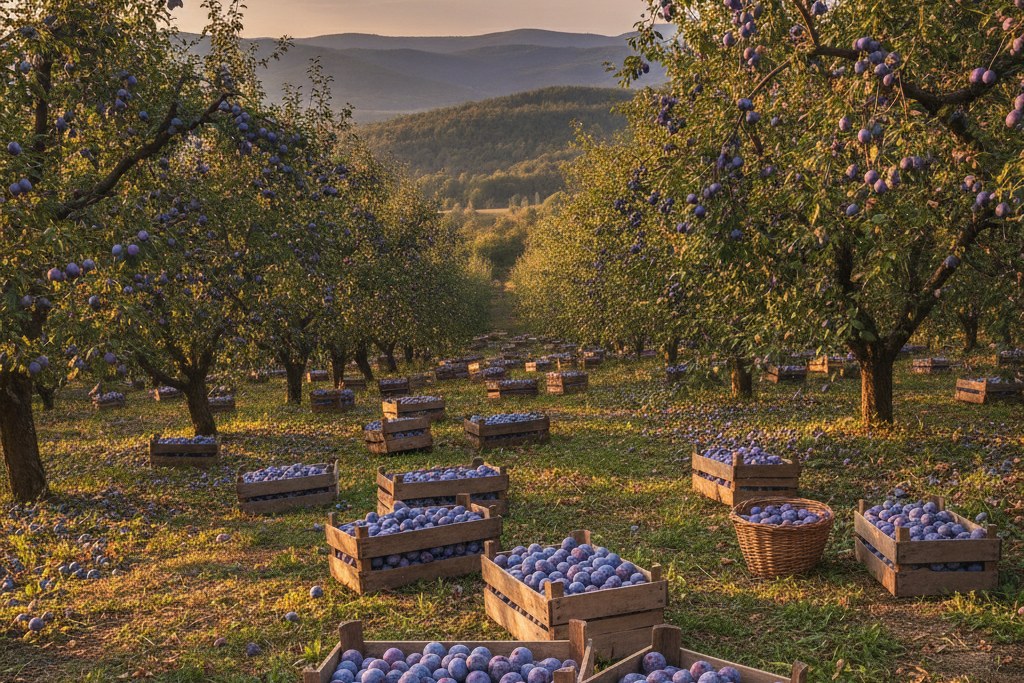
Plums suit the hills of central Serbia, Bosnia, and Slavonia so well that the region has been one of Europe's great plum belts for centuries. Serbia is still among the world's largest plum growers, and a large share of each harvest ends up in a still rather than a fruit bowl. The logic was practical long before it was cultural: ripe plums spoil in days, and brandy keeps for decades.
For most of its history šljivovica was a household product. Families distilled their own each autumn in a shared village still, and the quality of the house rakija was a matter of quiet reputation. It was poured at births, weddings, the family saint's day, and funerals alike. That is still true; the commercial bottles are the newer part of the story.
The modern chapter is about recognition. Serbia has protected "Srpska šljivovica" as a geographical name, and Croatia has done the same for "Slavonska šljivovica" from Slavonia. Then in 2022 UNESCO added the social practices and knowledge around making and using šljivovica in Serbia to its list of Intangible Cultural Heritage. It was the custom that was listed, not a brand: the family still, the toast, the glass handed to a guest.
How Šljivovica Is Made: From Orchard to Glass
Good plum brandy is decided in the orchard. The classic variety is Požegača, a small, dark, intensely sweet plum also known as Bistrica. Older Serbian producers swear by Crvena ranka, and many modern orchards grow varieties bred at the fruit institute in Čačak, such as Čačanska rodna and Čačanska lepotica. Whatever the variety, the rule is the same: fully ripe fruit, no rot, and no added sugar.
- 1 Harvest Late Aug – Sept
Plums are left until they are fully ripe and starting to drop. Sugar is everything, since nothing is added later.
- 2 Mash Same day
The fruit is crushed into a pulp called kom. Stones mostly stay whole: crack too many and the spirit turns bitter.
- 3 Ferment 2 – 4 weeks
Wild or added yeast turns the sugar into alcohol in open vats or barrels, giving a low-strength plum "wine".
- 4 First distillation October
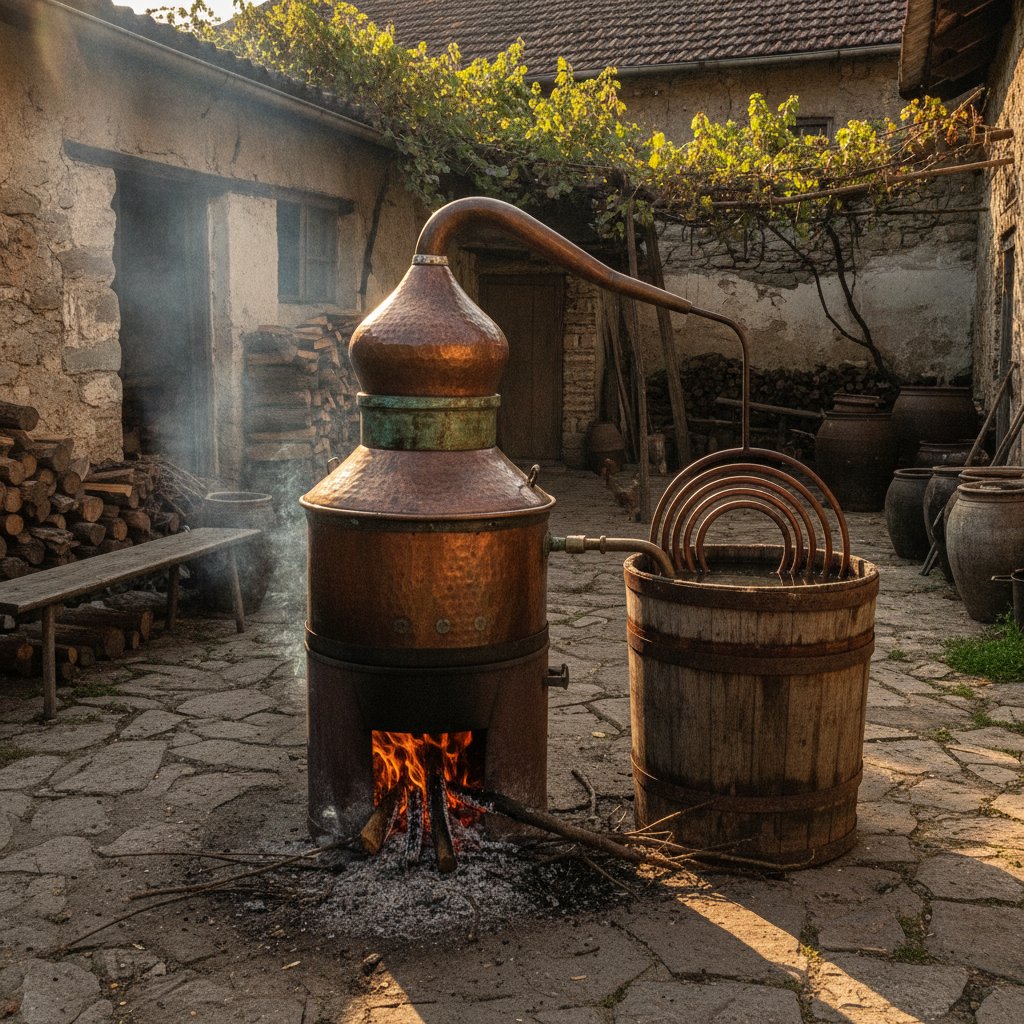
The mash goes through a copper pot still, the kazan. The result is meka rakija, "soft" brandy at roughly 25–30% ABV.
- 5 Second distillation October – November
Run again and it becomes prepečenica. The harsh first runnings and oily last runnings are cut away; only the heart is kept.
- 6 Rest or age Months to decades
Clear versions rest in glass or steel. Aged versions go into oak, sometimes mulberry or acacia, and turn gold.
The second distillation is what separates a serious šljivovica from a rough one. The distiller splits the run into three parts. The first runnings, called prvenac, are sharp and contain most of the unwanted compounds, so they are set aside. The last runnings, patoka, are weak and oily. Only the middle, the heart, becomes the drink. Where exactly to make those cuts is the skill people spend a lifetime arguing about.
How Strong Is Šljivovica? Alcohol Percentage and Proof
Bottled šljivovica is almost always 40–45% ABV, which is 80–90 proof on a US label. That puts it level with vodka, whisky, or gin. The reputation for being ferocious comes from the homemade stuff, where double-distilled prepečenica is often left at 50–60% and nobody has measured it very carefully.
For anyone counting: a standard 30 ml pour at 40% holds about 9.5 grams of alcohol and roughly 65 calories, nearly all of it from the alcohol itself. There is no sugar and no carbohydrate to speak of in an unsweetened fruit brandy.
What Does Plum Brandy Taste Like? Clear vs. Aged
There are two šljivovicas, and they drink very differently. The clear, unaged style is the direct one. It smells of fresh plum skin and something faintly almond-like from the stones, hits warm, and finishes clean. The aged style has spent years in a barrel, traditionally oak, and picks up colour, vanilla, dried fruit, and a softer landing. If you have only met the first kind, the second can be a revelation.
A quick way to read a label. Bistra or bela means clear or white. Stara means old, so "stara šljivovica" is an aged one. Prepečenica means double-distilled, and usually stronger. Domaća means homemade or house-style. A number of years on the front is an age statement, the same as on a whisky.
How to Drink Šljivovica Like a Local
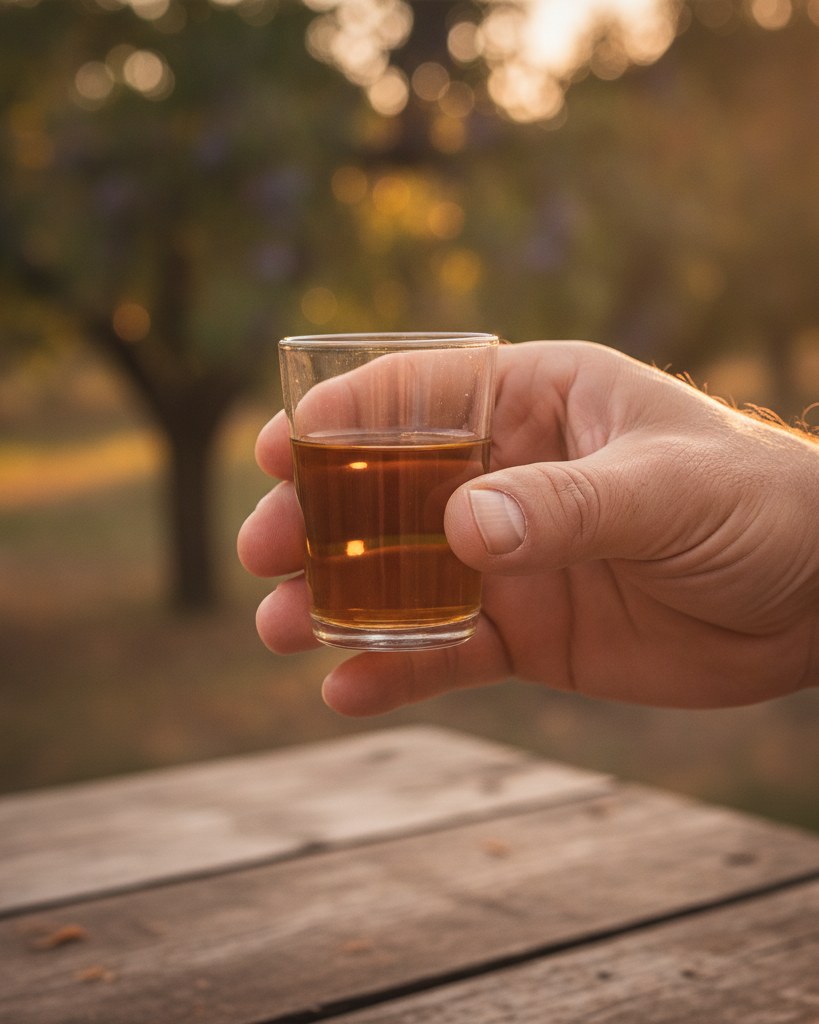
Small glass, room temperature, slow. In Serbia the traditional vessel is the čokanj, a tiny flask-shaped glass that holds about a shot and is built to be held in the palm. It is sipped across a conversation, not thrown back, and it rarely comes alone: expect cured meat, cheese, pickles, or bread on the table next to it.
Do
- Serve unaged at cool room temperature, aged slightly warmer
- Pour 30 ml or less and sip it
- Wait for the toast, and look people in the eye when you clink
- Eat something with it
Don't
- Keep a good aged bottle in the freezer; cold hides the flavour
- Shoot it. You will get there twice as fast and enjoy it half as much
- Refuse the first glass in someone's home without a reason
- Assume the unlabelled bottle is 40%
What to eat with it depends on the style. Clear šljivovica wants salt and fat: smoked ham, kajmak, hard sheep's cheese, pickled peppers. Aged šljivovica works after dinner the way a brandy does, with walnuts, dark chocolate, dried plums, or a strong coffee.
Slivovitz Cocktails: Four Ways to Mix Plum Brandy
Purists will tell you šljivovica is not for mixing. They are half right: a twelve-year-old bottle deserves a glass to itself. But a clear, everyday slivovitz is a dry, aromatic fruit spirit, and it behaves in a cocktail much like a pisco or an unaged brandy. The first drink below is a genuine Serbian winter tradition. The other three are how I mix it at home.
Šumadijski čaj ("Šumadija tea")
Traditional · served hot- 1 tbsp sugar
- 100 ml šljivovica
- 100 ml water
Melt the sugar in a small pot until it turns amber. Carefully add the water, then the šljivovica, and warm it through without boiling. Serve in small cups. This is the cold-weather drink of central Serbia.
Plum Brandy Sour
Clear slivovitz · shaken- 50 ml clear slivovitz
- 25 ml fresh lemon juice
- 15 ml simple syrup
- Optional: 1 egg white
Shake hard with ice and strain into a chilled glass. The lemon lifts the plum aroma and the sugar takes the edge off the heat. This is the best first cocktail for anyone new to the spirit.
Stara Old Fashioned
Aged šljivovica · stirred- 60 ml aged (stara) šljivovica
- 1 tsp honey or rich sugar syrup
- 2 dashes aromatic bitters
Stir over ice until well chilled, strain over one large cube, and finish with a strip of orange peel. An oak-aged plum brandy slots into this drink as easily as a bourbon does.
Šljiva & Tonic
Clear slivovitz · built- 40 ml clear slivovitz
- 120 ml tonic water
- Lemon wedge
Build over plenty of ice in a tall glass. Long, dry, and a good answer to the question of what to do with the rest of the bottle in summer.
Buying Guide: Which Slivovitz Should You Look For?
Outside the Balkans the choice usually comes down to a handful of exported labels. These are the names you are most likely to meet in a well-stocked shop in the US or UK, with what style each one is. I have listed them by style rather than ranked them, because the right bottle depends on what you want it for.
| Label | From | Style | Good for |
|---|---|---|---|
| Maraska Šljivovica | Zadar, Croatia | Croatian plum brandy, widely sold in a kosher-certified version | An easy-to-find first bottle |
| Badel Stara Šljivovica | Zagreb, Croatia | Oak-aged "old" plum brandy | Sipping after dinner |
| Stara Sokolova | Western Serbia | Oak-aged, sold with age statements | A serious sipping bottle or a gift |
| Žuta Osa ("Yellow Wasp") | Serbia | Aged, golden, on the stronger side | The classic Serbian aged style |
| Bistra | Serbia | Clear and unaged, as the name says | Cocktails and the traditional clear style |
| Manastirka | Serbia | Traditional Serbian plum brandy | Everyday pouring |
| Navip Slivovitz | Zemun, Serbia | Long-exported Serbian label | Often the one on the shelf |
| R. Jelínek | Vizovice, Czechia | Czech slivovice, clear and gold versions | Comparing the Moravian style |
| Zwack | Hungary | Hungarian kosher plum brandy | Passover, and comparing the Hungarian style |
Four things to check before you buy
- Clear or aged? Decide this first. Clear for mixing and for the traditional fiery style, aged for sipping.
- The ingredient line. It should say plums, or plum distillate. Avoid anything listing neutral spirit with flavouring, or "plum flavoured brandy," which is a different and much sweeter product.
- The ABV. 40% is gentle, 45% has more grip and more aroma. Anything at 50% or above is a sipping-with-water proposition.
- Price as a signal. Clear and young bottles tend to sit around the price of a mid-shelf vodka. Long-aged bottles with an age statement cost more, for the same reason old whisky does: years of evaporation in a barrel.
Is slivovitz kosher?
Often, yes, and there is a long history behind it. Because it is distilled from fruit rather than grain, slivovitz became the traditional spirit for Passover among Jewish communities in Central and Eastern Europe, when grain-based spirits are off the table. Several producers bottle a certified kosher-for-Passover version. Check for the certification mark on the label, as not every bottle from a given brand carries it.
How to store it
Upright, sealed, and out of direct sunlight. At 40% and above it will not spoil, and an opened bottle stays good for years. It also will not improve: ageing happens in the barrel, not in the glass bottle, so there is no reason to save it.
Slivovitz vs. Rakija, Pálinka, Țuică, and Plum Wine
These get confused constantly, so here is how they actually relate.
| Drink | What it is | How it differs from šljivovica |
|---|---|---|
| Rakija | The Balkan family name for fruit brandy | Šljivovica is one type of rakija, the plum one. All šljivovica is rakija; not all rakija is šljivovica. |
| Slivovitz | English and German spelling | No difference. Same drink, different alphabet habits. |
| Slivovice (Czech) | Moravian plum brandy | Same idea, usually clear, and often bottled a little stronger. |
| Szilvapálinka (Hungary) | Plum pálinka | Made under Hungary's own pálinka rules; typically clear and very fruit-forward. |
| Țuică (Romania) | Romanian plum spirit | Often distilled once and bottled weaker; the stronger double-distilled version has its own names. |
| Umeshu (Japan) | "Plum wine" | Not distilled from plums at all. Fruit is steeped in spirit with sugar, giving a sweet liqueur around 10–15%. |
| Plum-flavoured brandy | Flavoured, sweetened spirit | Grape brandy or neutral spirit with plum flavour and sugar. Much sweeter, usually weaker. |
If you want to see how plum brandy sits alongside the pear, quince, grape, and herbal members of the family, the Rakija guide covers them all, and the Serbian Rakija page goes deeper on the country that treats šljivovica as a national symbol.
Frequently Asked Questions
What is slivovitz?
Slivovitz is a fruit brandy distilled from fermented plums. It is the English and German spelling of šljivovica, the plum brandy made across Serbia, Bosnia and Herzegovina, Croatia, and the wider region. It is dry, not sweet, and usually bottled at 40–45% ABV.
Is šljivovica the same as slivovitz and plum brandy?
Yes. Šljivovica is the name in Serbian, Croatian, and Bosnian, slivovitz is the spelling used in English and German, and plum brandy is the direct translation. All three describe a spirit distilled from plums.
What is the difference between slivovitz and rakija?
Rakija is the general Balkan word for fruit brandy. Slivovitz, or šljivovica, is the specific rakija made from plums. Rakija can also be made from pears, quinces, apricots, or grapes.
How strong is slivovitz?
Commercial slivovitz is typically 40–45% alcohol by volume, or 80–90 US proof. Homemade double-distilled versions are often stronger, commonly 50–60%.
How do you pronounce šljivovica and slivovitz?
Šljivovica is pronounced SHLYEE-vo-vee-tsa. Slivovitz is pronounced SLIV-uh-vits.
How should you drink slivovitz?
In a small glass, at room temperature, sipped rather than shot, usually with a little food such as cured meat, cheese, or pickles. Aged slivovitz is best neat after a meal. Clear slivovitz also works well in a sour or with tonic.
Does slivovitz go bad?
No. At 40% ABV or more it does not spoil. Store it upright, sealed, and away from sunlight. It will keep for years after opening, though it does not improve with age once bottled.
Why is slivovitz popular at Passover?
Slivovitz is distilled from plums rather than grain, so certified versions are suitable during Passover when grain-based spirits are avoided. It has been a traditional Passover spirit in Central and Eastern European Jewish communities for generations.
Is plum brandy sweet?
Traditional plum brandy such as šljivovica is not sweet. It is a dry distilled spirit with plum aroma. Sweet products labelled plum liqueur, plum wine, or plum-flavoured brandy are different drinks.
Is the Manet painting "Plum Brandy" about slivovitz?
Not really. Édouard Manet's painting from around 1877, known as The Plum or Plum Brandy and held at the National Gallery of Art in Washington, shows a woman in a Paris café with a plum soaked in brandy, a French café treat rather than Balkan šljivovica.
Na zdravlje! Start with a clear one, graduate to a stara, and if someone offers you their own, say yes. Then head back to the full Rakija guide for the rest of the family.